
Protect Te Waikoropupū Springs, forever.
Te Waikoropupū Springs, revered by Māori and cherished by all New Zealanders, are renowned for being among some of the purest waters on Earth.
Right now, these sacred waters are under threat from Federated Farmers calling for all Water Conservation Orders to be removed from the Resource Management Act. The Springs are also threatened by a potential gold mining operation. While the gold mining permit at Sams Creek has been declined - which is a huge relief - the fight isn’t over yet.
The Save Our Springs campaign (SOS) is ongoing in the defence of Te Waikoropupū Springs. Help us bring Sams Creek into Kahurangi National Park, so that the headwaters that feed the springs are safe forever.
The fight to protect Sams Creek, the Tākaka River and Te Waikoropupū Springs isn’t over yet.
Mohua (Golden Bay) has been facing an unprecedented threat: a potential Gold Mining Operation circumventing our hard-won Water Conservation Order bringing the threat of potentially irreversible toxic contamination to the aquifer that feeds the springs and on which our community relies on for drinking water.
In May 2026, New Zealand Petroleum and Minerals declined Siren Gold's application to mine Sams Creek, finding it failed the legal tests under the Crown Minerals Act. Siren's exploration permit has since expired, so there are no active mining permits over the land today. But the door isn't closed. NZP&M must now make a land status decision, expected around mid-August 2026, that will shape whether Sams Creek could be opened to mining again. Siren Gold has said it is weighing its options, including a possible appeal, and that it could re-apply if the land becomes available.
There is a way to protect this place for good. Mining is not allowed in National Parks. If Sams Creek and the neighbouring conservation land are brought into Kahurangi National Park, no company could mine it. This is what our petition asks for.
Be bold — expand Kahurangi National Park
We're calling on the Minister to recommend to the Governor-General that Sams Creek, along with the Tākaka River and Cobb Valley conservation areas beside it, be added to Kahurangi National Park under the National Parks Act 1980.
Sams Creek sits right on the edge of Kahurangi National Park, and it belongs there. The only reason it was ever left out was to allow the gold exploration. The fight to protect the place has spanned over decades.
Sam’s Creek: Fast-Track to Desecration
The story of a community mobilising to protect the natural world and nature's special places.
We want as many people as possible to know the story of Sam’s Creek.
We hope this film will aid in protecting other special places in Aotearoa that are also threatened by the fast-track legislation. It is the story of a community mobilising to protect the natural world and nature's special places.
We would like to thank the research team here in Mohua for the scientific information contained in the film.
www.SaveOurSprings.nz campaign lead: Kevin Moran
Independently produced, shot, directed, edited by Timothy Firkin
Te Waikoropupū Springs Water Conservation Order is now under threat!
Te Waikoropupū Springs have some of the clearest water ever measured on
earth. In 2023, the Springs were protected by a Water Conservation Order
(WCO). The WCO gives a special cloak of protection that councils must abide
by when considering resource consents.
In late 2025, the Government plans to replace the Resource Management Act (RMA). Federated Farmers is asking the Minister to remove the Te Waikoropupū Springs WCO and all WCOs from the future resource management system. If this were to happen, Te Waikoropupū Springs would be at significant risk from pollution. Te Waikoropupū Springs would also lose the protection the WCO gives if resource consents are sought for mining at Sams Creek.
All other precious waterways which are protected by WCOs, would also be similarly at risk. It’s time to draw the line and protect our most precious and endangered waterways.
Please also sign our urgent petition to protect all Water Conservation Orders.
The Unseen
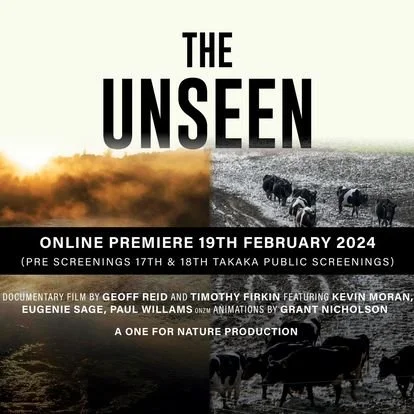
A film about the battle to save our nations purest waters, Te Waikoropupū Springs.
The Unseen; is a 22 minute film produced by talented filmmakers Tim Firkin and Geoff Reid. It tells the story of the battle to protect the springs by protecting the tiny unseen creatures that clean the aquifer.
Be Bold and Expand Kahurangi National Park!
We urge the Minister to make a recommendation to the Governor General:
To declare the areas (in link below) be included withinKahurangi National Park and subject to the National Parks Act 1980:
Conservation Area - Sams Creek
Conservation Park - North West Nelson Forest Park - Tākaka River - Cobb Dam Road
Conservation Area - Tākaka River
Map of area to be considered: https://docs.google.com/document/d/1tjnu-XN4ckrZyRI0KfiVOXzbMCn-iTCROC3s2MG_pt8/edit?tab=t.0
Why is this important?
To protect Sams Creek and Te Waikoropupū Springs
On the 8th of March 2024, a community gathering at Sams Creek made the following declaration: ‘We declare that Sams Creek and its whenua are an integral part ofKahurangi National Park , and one day this will be recognised by the Parliament of Aotearoa, New Zealand.’ The petition is a step towards fulfilling this declaration.
Te Waikoropupū Springs are the largest cold-water springs in the Southern Hemisphere and have some of the clearest water ever measured on Earth. In 2023, the Springs received a Water Conservation Order (WCO) from the Environment Court. The WCO gives a special cloak of protection which councils must abide by when considering resource consents. However, the framework for managing environmental effects has changed significantly with the introduction of the Fast Track Approvals Act, which significantly weakens environmental protections when it comes to mining proposals.
Sams Creek and the listed areas are upstream from Te Waikoropupū Springs. The gold ore at Sams Creek contains a rich brew of toxic metals, including 75,000 tonnes of arsenic. It has been safe underground in solid rock for untold millions of years. But if it were mined, it would all be brought to the surface, ground to a fine powder, treated with cyanide to extract the gold, and then dumped as toxic waste. One proposal was to pile the waste behind a dam on the steep, unstable slopes of Sams Creek. Mining companies promise they can keep it isolated forever, but history shows otherwise.
If the slime heap dam were to break, as is inevitable in a flood and earthquake-prone area like Sams Creek, the arsenic-laden waste would flow down the Tākaka River and enter the Arthur Marble Aquifer, which feeds Te Waikoropupū Springs. This would be a total disaster! The tiny creatures that clean the aquifer would die. The crystal-clear waters would be lost forever. Not only that, local drinking water, farms and businesses would be seriously threatened.
If Sams Creek and the other listed areas are included within Kahurangi National Park, hard rock gold mining could not take place. Mining is not allowed in National Parks. Waikoropupū would be safe!
There are other good reasons to place the listed area in Kahurangi National Park. Geographically, the listed area is adjacent to Kahurangi National Park. This area is just as rare and beautiful as the National Park. Simply put, Sams Creek and the other listed areas belong naturally in Kahurangi National Park.
The only reason Sams Creek is not already part of Kahurangi is that a previous government left it out to allow gold exploration. That exploration has now taken place, and it has become abundantly clear that Sams Creek is entirely unsuited for hard-rock gold mining. You can discover scientific information on this at Sams Creek Collective – Safeguard Mohua waterways and aquifers, or Save Our Springs
Let’s draw the line now. Let’s take a bold and positive step forward by creating a strong petition to the Governor General and the Minister.
As we take this step, we respect and honour the environmentalists and politicians from the political parties of the time who worked hard to create the treasure that is Kahurangi National Park. We further respect and honour Manawhenua ki Mohua and other Iwi whose Kaitaki status is integral to the protection of Sams Creek, Te Puna Waiora o Waikoropupū, and the waters of Mohua (Golden Bay).
You can add your name here.
Links:
A gold mine at Sams Creek! Here’s What we know so far:
1. Siren Gold intends to extract ore with a very high arsenic content.
by tunneling into the Sam’s Creek area. Ore may also be mined using the opencast method. Ore is to be taken out through the tunnels to a processing plant to be built at Barron Flats.
2. The processing plant will grind the ore to a fine toxic dust.
Chemicals and water will be added to make a slurry so it can concentrate the gold, using a flotation process. Siren currently plans to export the concentrate overseas and extract the gold from it using cyanide – but it hasn't ruled out using cyanide at the Barron Flats processing plant. There’s nothing to stop Siren Gold, from changing the conditions of the consent, after the fact, to use cyanide.
3. The rest of the ore powder will go into a huge waste heap. It will contain over 10 million tonnes of crushed ore, which is expected to contain roughly 70,000 tonnes of arsenic.
Enough arsenic to kill the entire world population.
The waste heap will be lined with clay to stop the arsenic waste from getting into the aquifer and contaminating the groundwater. However, this type of clay waste heap is typically suited to arid, dry conditions, not the type of weather seen in the Upper Takaka Valley which experiences around two meters of rain a year. The area is subject to periodic earthquakes and big floods.
4. Overseas, experience shows that waste heaps have a high incidence of failure, allowing their toxic contents to pollute rivers and creeks.
In the Upper Takaka Valley, which is covered in tomos (or sinkholes), waste heap failure would lead to arsenic getting into the groundwater potentially killing the tiny creatures that clean the aquifer, and, poisoning drinking water. Arsenic can also bio-accumulate through our food chain - plants to animals to humans.
5. Waste heap failure can happen during the mine operation, or after the mine is closed.
Either way, there's nothing you can do once you discover arsenic in the rivers or groundwater. Once rising arsenic levels are detected in water it's already too late, the mining company is often long gone. Arsenic has no half-life and is essentially there forever.
6. The most common cause of arsenic poisoning is contaminated drinking water.
Arsenic pollution is an invisible killer. – Arsenic lasts forever.
Join us in standing for the future and wellbeing of our region:
Save Our Springs submission on the Natural Environment Bill and Planning Bill - April 2026
To: Environment Committee
Parliament Buildings
Wellington
Submitter Details:
Full Name: Save Our Springs Aotearoa New Zealand Inc
Contact: Kevin Moran
Address for Service: 1075b Upper Tākaka Highway, RD1, 7183
Email: saveoursprings2018@gmail.com
13 February 2026
Submission on the Natural Environment Bill and Planning Bill
Introduction
1. Save Our Springs Aotearoa New Zealand Inc (SOS) is an incorporated society. It was formed in 2017, and its current membership numbers around 120 people across New Zealand. It currently has a list of just over 30,000 supporters. The primary purpose of SOS is to protect the aquifers, lakes and rivers of Aotearoa New Zealand. Actions the society may take to carry out this purpose include:
a. making submissions and advocating for the protection and care of any aquifer, lake or river; and
b. disseminating information to inform the public about the state of these water bodies and any threats to their health.
2. The focus of SOS’s work has been to protect the pristine waters of Te Waikoropupu Springs, including restoring the health of the Tākaka catchment near the top of the South Island and the aquifer that feeds the Springs. SOS was instrumentally involved in the water conservation order (WCO) recently made in respect of the Springs. (Te Puna Waiora o Te Waikoropupū Springs and Wharepapa Arthur Marble Aquifer Water Conservation Order 2023).
3. SOS thanks the Environment Committee for the opportunity to make a submission on the Natural Environment Bill (NEB) and Planning Bill (PB) (together, the Bills).
4. The focus of our submission is on aspects relevant to WCOs, particularly:
The importance of retaining WCOs in the new system. WCOs remain necessary as they provide the primary instrument for freshwater protection equivalent to those established for coastal and terrestrial environments such as marine reserves and national parks.
The deletion of “spiritual” and “cultural” purposes from the list of matters that WCOs may provide for (Natural Environment Bill, Schedule 4 cl 1(2)(b)(v)). SOS considers spiritual and cultural considerations should be retained because deleting them would leave an unconscionable and unjustifiable gap.
The restriction of appeals to points of law only (Natural Environment Bill, Schedule 4 cl 12). SOS considers merits appeals to the Environment Court should be provided for, to improve rigour and because the Environment Court is the most appropriate forum in which contentious merits-based issues relating to the environment should be finally considered and decided.
The express obligation on “the relevant consent authority” to monitor the effect and implementation of a WCO (Natural Environment Bill, Schedule 4 cl 3(2)(d) and s 227). This is supported by SOS, but further amendments are needed to clarify that consent authorities are responsible for enforcing compliance.
Retaining WCOs is strongly supported
5. SOS strongly supports the retention of WCOs in the new resource management system. Aotearoa New Zealand’s freshwater is under significant pressure from a multitude of stressors, including from the effects of climate change and land use intensification, and our most outstanding water bodies are not immune from these effects (Ministry for the Environment & Stats NZ (2023) New Zealand’s Environmental Reporting Series: Our freshwater 2023, available here; Ministry for the Environment & Stats NZ (2025) New Zealand’s Environmental Reporting Series: Our environment 2025 | Tō tātou taiao).
6. WCOs offer powerful protection by setting rules which authorities must abide by when managing outstanding waterbodies and associated land use activities. They have been aptly described by some as the “national parks of freshwater” and, without them, Aotearoa New Zealand’s outstanding water bodies will be at risk of irreversible degradation (6 Ministry for the Environment Information sheet: Water conservation orders).
7. Given the ongoing and significant decline of quality and ecological health of Aotearoa New Zealand’s water bodies, water conservation orders remain a critical tool in the planning toolbox. They remain necessary as they provide the primary instrument for freshwater protection equivalent to those established for coastal and terrestrial environments such as marine reserves and national parks.
8. The provisions of the NEB relating to WCOs (Schedule 4 and s 124) are very similar to those found in the RMA. However, some changes have been made that have significant implications for the identification and protection of outstanding water bodies. These are addressed below.
Spiritual and cultural aspects should be reinstated
9. The NEB reduces the types of characteristics of a water body which may be identified for protection as outstanding, by removing cultural and spiritual considerations from cl 1(2)(b)(v) of Schedule 4.
10. SOS considers cultural and spiritual considerations should be reinstated. They are currently recognised in s 199 RMA and have been applied effectively. Deleting them would leave a significant gap, because it would exclude important relational and deeply human aspects of spirituality such as sacredness that may not otherwise be protected. The concept of spiritual or sacred waters connotes a pristine quality, rather than a functional but degraded water quality.
11. Furthermore, the Courts and other decision-makers are well-used to considering Māori spiritual and cultural values of outstanding waterbodies under cl 199(2)(c). (Section 199(2)(c) is: The protection of characteristics which any water body has or contributes to, and which are considered to be of outstanding significance in accordance with tikanga Māori). That clause has largely been retained in the NEB (except that the reference to tikanga has been deleted (Clause 1(2)(c) of Sch 4 NEB). SOS supports the retention of that clause and would support reinstatement of the reference to tikanga Māori in that clause to avoid continuing erosion of indigenous rights.
12. However, SOS submits that it would be inconsistent to protect waterbodies’ outstanding Māori cultural and spiritual values while refusing to protect outstanding cultural and spiritual values where they are held by non-Māori.
Rangitata River
13. Spiritual and cultural values are listed as outstanding characteristics of the Rangitata River in the Rangitata River WCO (Ministry for the Environment, Water Conservation (Rangitata River) Order 2006 (NZ Gazette, 23 June 2006), Schedule 2).
14. The Special Tribunal that considered the Rangitata WCO application considered: (Rangitata River Water Conservation Order Application, Report by the Special Tribunal (October 2002), at [326])
“spiritual purposes” to be those that concern the dimension of reality that gives worth
or value to something that is witnessed or experienced; this dimension is intangible
and resists definition and measurement, but it is readily understood from
comparable experiences.
15. The Tribunal further considered: (At [329]) Cultural and spiritual attributes are closely linked and cover a spectrum of values. We consider that the following characteristics contribute to cultural and spiritual values:
• shared community history
• inter-generational transfer of cultural values, information and skills
• physical health and sustenance
• significance for present and future generations
• contribution to spiritual and cultural cohesion
• spiritual continuity.
16. The Tribunal described evidence from submitters about the feelings and emotion they experienced at the River, and their attachment to it (At [331]-[334]). These included explicit comments about spirituality, such as experiencing "the powerful aura of the place" and being "inexplicably attracted to the Rangitata River" (At [331]). They also included experiences not explicitly labelled as spiritual: (At [332]).
In addition to those who mentioned spiritual values directly, others spoke of similar
feelings including: the magic of the Rangitata River, the pure pleasure of being there
and how it has held a spell over their lives. They spoke of the peace, tranquillity, the
beauty and grandeur, and the inherent wild and scenic qualities, especially in the
upper river. The wild turbulence of the white water in the gorge and the sheer
volume of water in this river demands respect (Tipa 2000). The feeling of space and
wideness of the sky at the mouth, and beautiful sunrises and sunsets were described.
17. In relation to the relevant factors of spirituality, the Tribunal concluded: (At [340], emphasis added)
It is not only Māori who perceive that water bodies, especially those largely in a
natural state, have a life-giving vitality. The value of the river for these purposes is
clearly something that is wider than their fishing or other active and passive
recreational pursuits. The factors that are considered to provide the spiritual importance
are generally those that are linked to the highly natural appearance, as well as the wild
character and behaviour of the river. We note that in the lower [braided] river, these
values persist under the current flow regime even where the waters are no longer in
their natural state.
18. In relation to assessment of whether the relevant spiritual values were outstanding, the Tribunal did not measure the spiritual values on a comparative national basis. The Tribunal found that spirituality “resists definition and measurement” , presumably because it recognised that spirituality is related to “something that is witnessed or experienced” (At [326]). The evidence summarised by the Tribunal of experiences and emotions were related to the River itself. The Tribunal concluded that the spiritual aspects “are very special, and therefore outstanding” (At [341], emphasis added). The closest the Tribunal came to measurement was to note that the spiritual connections with the River were “strong” (At [340]).
19. No person appealed or questioned the Tribunal’s findings on outstanding spiritual characteristics (Interim Report on a Proposed Rangitata Water Conservation Order, EnvC, C109/2004 (5 Aug 2004), at [102]), and they were included in the Draft Order (Clause 4, at Appendix 5.2). The final Order includes spiritual values as outstanding characteristics of the Rangitata River (Ministry for the Environment, Water Conservation (Rangitata River) Order 2006 (NZ Gazette, 2 June 2006), clause 4).
20. It is also noted that earlier decisions have also used other terms for assessment. For example, pre-RMA, “outstanding” was defined as “conspicuous”, “eminent”, “special by excellence” or “standing out from the rest” (Re National Water Conservation (Mataura River) Order 1989 (Planning Tribunal, C 32/90, 4 May 1990) at 40 It was confirmed in the first WCO) inquiry held under the RMA that the word “outstanding” in the RMA should be interpreted in the same manner as it had under the previous legislation (the Water and Soil Conservation Act 1967) (Re National Water Conservation (Kawarau) Order 1993 (Planning Tribunal, C 33/96, 13 June 1996) at 20).
Te Waikoropupū Springs
21. Spiritual and cultural values are also listed as outstanding characteristics of Te Waikoropupū Springs in the Te Waikoropupū Springs WCO (Te Puna Waiora o Te Waikoropupū Springs and Wharepapa Arthur Marble Aquifer Water Conservation Order 2023, cl 5(2)(a) and 5(2)(h)).
22. The Special Tribunal considering the Water Conservation Order for Te Waikoropupū Springs received some evidence on the Springs' spiritual values (Special Tribunal recommendation report on the application for Water Conservation Order on Te Waikoropupū Springs and associated water bodies (March 2020) at [305]). The evidence that was received was "from a wide variety of submitters regarding their emotional response when experiencing the Springs’ environment"; this was considered "to be evidence of the spiritual aspect and values of the Springs" (At [309] (footnote omitted)).
23. SOS produced evidence to the Environment Court on the spiritual qualities of Te Waikoropupū Springs. This evidence draws on existing information regarding peoples’ spiritual connection to the Springs, in terms of the characteristics set out in the Rangitata Tribunal report.
24. A consultant’s report on community perceptions of Te Waikoropupū Springs found that the community participants wanted the spiritual characteristics of Te Waikoropupū acknowledged and protected (Lucas Associates, Te Waikoropupū Community Consultation Report (1999). [Report produced for the Department of Conservation and Tasman District Council, June 1999.]). This Report is clear that the vision of the participants was wide and inclusive, and not limited to the Māori cultural dimension of spirituality, referring to the Springs as “sacred” (At p 8) as an “essential treasure” (At p 9), as “a place of pilgrimage and spiritual learning” (At p 20), and as” a place of healing and spiritual renewal” (At p 22). It was noted that: (At p 67)
... visits [to the Springs] are primarily about contemplation of the wonders of nature and reverence for important spiritual and sacred waters.
25. It was explained to the Court how people find the Springs to have a sacredness that is unique and spiritually renewing and hence outstanding (and extraordinary). The Environment Court held: (Ngāti Tama ki te Waipounamu Trust and Andrew Yuill [2023] NZEnvC 157, at [54]
Those are of course personal experiences. Nevertheless, our site visits enabled us to appreciate how the special qualities of the Springs include the way people experience them as spiritually rejuvenating and renewing. It is associated with the vibrancy and purity of the waters in their peaceful setting. We adjudge that the Springs have outstanding spiritual values.
26. All parties involved in the WCO application agreed with the inclusion of spiritual values in the WCO as an outstanding characteristic of Te Waikoropupū Springs.
27. Humans have always had a connection with water that goes beyond the practical. The ancient Greeks revered sacred springs as sources of divine power, associated with healing, prophecy, and religious rituals. 19th century Europeans recognised the therapeutic value of water. That connection lives on. SOS invites members of the Environment Committee who have not previously visited Te Waikoropupū Springs to do so, and to experience for themselves the deeply human and undeniably spiritual feelings that arise in the presence of this waterbody.
28. If the reference to “cultural” and “spiritual” values is not included as an outstanding characteristic in the NEB, this will unjustifiably prevent other water bodies being recognised and protected as outstanding on this basis. Merits appeals to the Environment Court should be enabled
29. Unlike s 209 of the RMA (RMA, s 209), cl 12 of Schedule 4 restricts appeals to the Environment Court to points of law only.
30. SOS considers this should be amended to allow appeals on merits in the same way as s 209 RMA, because:
a. Most WCOs currently in place have undergone merits appeals and this is a critical step as the Environment Court’s inquiry provides an added layer of scrutiny, including further fine-tuning, of a proposed order. The inquiry into merits enables a more rigorous testing of expert evidence, including via cross-examination and Court facilitated conferencing, to determine whether values meet relevant criteria or whether an order is in fact necessary.
b. The Environment Court is the most appropriate forum in which contentious merits-based issues relating to the environment should be finally considered and decided. The Court is often called upon to make judgments, based on evidence, on the level or magnitude of considerations similar to those required for WCOs, and it is not appropriate for Ministerially-appointed special tribunals to be the only (and final) decision maker on these matters.
Councils should be tasked with monitoring and enforcement
31. SOS supports the monitoring requirements under cl 3(2)(d) of Sch 4 and s 227 of the NEB. Clause 3(2)(d) will help to clarify that councils must undertake monitoring in relation to WCOs and assist regional councils in undertaking their responsibilities, including regulating and managing water quality and quantity, under cl 221.
32. However, SOS considers further amendments are needed to clarify that consent authorities are responsible for enforcing compliance. Consent authorities are best placed to enforce direct compliance with WCOs, rather than the Minister for the Environment.
Recommendations
33. SOS recommends that the WCO provisions in the NEB are retained, subject to the following amendments:
a. Clause 1(2)(b) of Sch 4 of the NEB is amended to include “cultural and spiritual” values.
b. Clause 1(2)(c) of Sch 4 of the NEB is amended to refer to “outstanding significance ... in accordance with tikanga Māori”.
c. Clause 12 of Sch 4 is amended to enable merits appeals to the Environment Court.
d. In Part 6 “Enforcement and other matters” the words “restriction or prohibition in a water conservation order” should be added to listed matters in: NEB clauses 243(1), 245(1)(a)(i), the definition of “incident”, 258(1)(a)(i), (b)(i), and (d)(iii), 266(1)(a)(i), (b)(i).
e. “Any relevant water conservation order” should be added to the listed matters in cl 97(2)(a) of the NEB and cl 80(2) of the PB.
Wish to be heard
34. SOS wishes to be heard in support of this submission.
Kevin Moran and Ione Grace
For Save our Springs Aotearoa New Zealand Inc.
Full Name: Save Our Springs Aotearoa New Zealand Inc
Contact: Kevin Moran
Address for Service: 1075b Upper Tākaka Highway, RD1, 7183
Email: saveoursprings2018@gmail.com
Your voice matters.
In just 3 simple steps we can ensure your voice reaches parliament.
-

1. Sign the Petition
Join Over 20,000 concerned kiwis in Join thousands of Kiwis calling for Sams Creek and the surrounding whenua - the headwaters that feed Te Waikoropupū Springs - to be included in Kahurangi National Park to be protected forever.
-
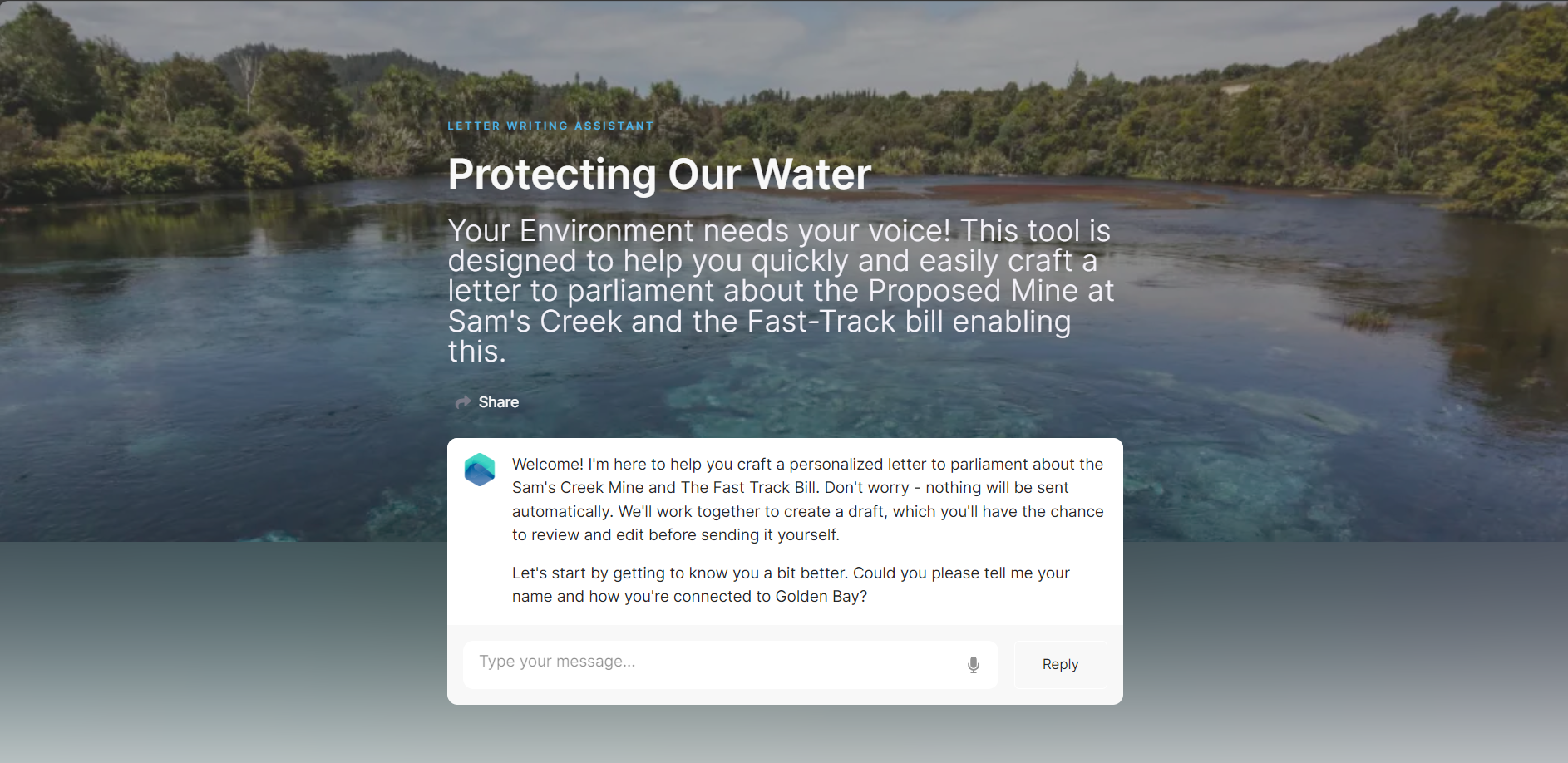
2. Craft a letter to your MPs
We’ve created an AI-powered conversational letter writer, designed to help you craft a personalised and compelling letter to all the government officials that will be voting on the Fast-Track Bill.
-
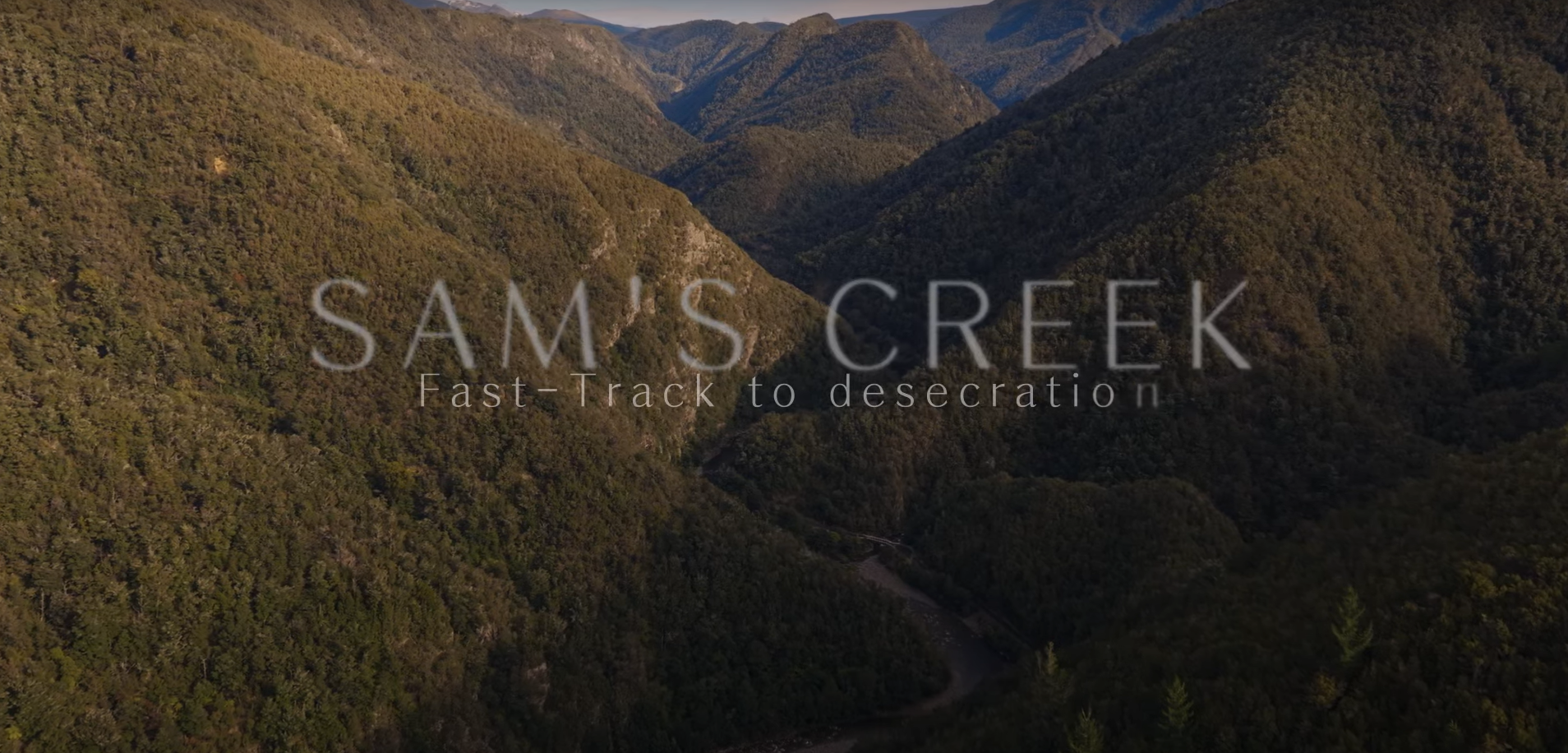
3. Share The Sam's Creek Documentary
We need as many voices added to our cause as possible. Share the “Sam’s Creek - fast-track to desecration” Documentary with as any people as you can.
Nature needs your voice!
We've built a letter writing tool to help you quickly and easily share your concerns with parliament.
We’ve created an AI-powered conversational letter writer, designed to help you craft a personalised and compelling letter to all the government officials that will be voting for the Fast-Track Bill. The tool quickly and easily helps you craft a letter in opposition to the fast track bill, the proposed mine at Sam’s Creek and to protect Waikoropupū Springs.



The Save Our Springs Campaign has been a collective journey by many people over the seven years of our existence. Many generous and hard-working people joined us in the waka that is SOS. We want to acknowledge the contribution of these generous people. Without them, SOS would not exist.
Our long standing fight for Te Waikoropupû
Don't fast track Te Waikoropupū!
Join the petition that has gathered over 20,000 signatures.
Over 20,000 concerned New Zealanders have already signed our petition that will be delivered to parliament next week. Urging cabinet:
Not to list Sams Creek Mine in Schedule 2 of the Fast-Track Approvals Bill, in recognition of the significant risk to Te Waikoropupū Springs
To amend the Fast Track Approvals Bill (by Supplementary Order Paper if necessary) so that activities that are contrary to any of the sixteen Water Conservation Orders are specifically excluded from the Bill.
There’s still time to add your voice to this urgent matter.

“ We don’t have the right to ask whether we are going to succeed or not. The only question we have the right to ask is what’s the right thing to do? What does this Earth require of us if we want to continue to live on it? “
— Wendel Berry